
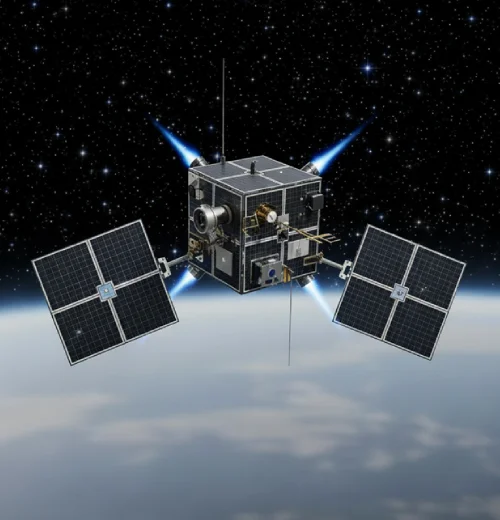
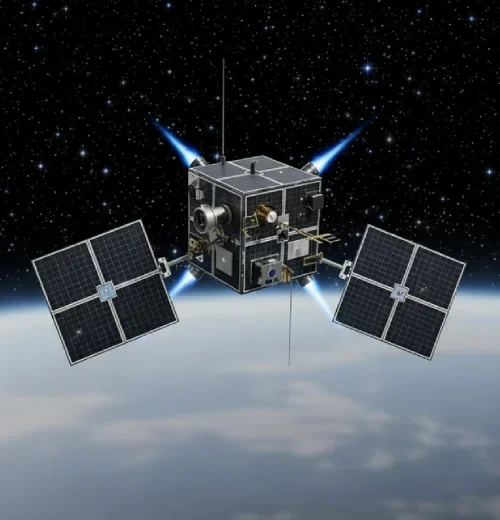
Sigma Series GEO Small Satellites
Sigma Series GEO Small Satellites are RSat Space’s next-generation geostationary platforms, delivering big-satellite capability in a compact, cost-efficient spacecraft.
Designed for defense, government, telecom and data service providers in Montréal, Canada and worldwide, Sigma enables tailored GEO communications and ISR missions with shorter schedules, lower launch mass and agile payload integration compared with traditional GEO spacecraft.
GEO Performance In A Small Package
Sigma Series GEO small satellites compress geostationary capability into 60–120 kilogram spacecraft while supporting payload powers typical of larger buses. The compact design cuts launch mass, streamlines integration and opens GEO missions to organizations priced out of conventional satellites.
From a single geostationary slot, a Sigma platform can continuously cover vast regions for communications, surveillance or environmental monitoring. Users in Montréal, across Canada and internationally gain persistent coverage without managing many low orbit passes or complex tracking networks.
By shrinking GEO buses, RSat Space enables architectures that once demanded a single multi-ton spacecraft to be delivered instead by coordinated Sigma satellites. Customers can phase capabilities over time, refresh technology faster and spread risk across multiple affordable GEO assets.
Mission Profiles For GEO Customers
Sigma Series GEO small satellites are engineered for missions needing persistent presence: secure broadband, tactical intelligence, border security, maritime awareness, disaster response and infrastructure monitoring. Each platform hosts communications, EO/IR, SIGINT or hybrid payload suites tailored to defined operational concepts.
Traditional multi-ton GEO spacecraft often force customers to lock in one mission profile for fifteen years or more. Sigma lets program managers field focused payloads faster, add follow-on satellites as budgets allow and evolve architectures without restarting decade-long procurement cycles.
Operators serving North American, Atlantic or European footprints can design Sigma missions around specific longitudes, beam patterns and sensor footprints. We work with customers to shape coverage, link budgets and imaging geometries so GEO assets match real operational theaters.
Propulsion, Station Keeping And Maneuverability
Sigma buses incorporate high-efficiency electric propulsion, including Hall-effect thruster options, sized for small GEO satellites. These systems handle orbit-raising, station keeping and end-of-life maneuvers while preserving as much propellant margin as possible for lifetime extension or contingency operations.
Advanced guidance and control algorithms continuously optimize thrust strategies against mission objectives, disturbance environments and fuel availability. Internal studies indicate reductions in station-keeping fuel usage, releasing additional mass for payloads or enabling longer operational lifetimes in geostationary orbit.
For customers needing orbital agility, Sigma is designed to work with RSat Space orbital transfer vehicles or compatible tugs. This combination supports relocation between slots, cislunar logistics concepts and responsive deployment of GEO assets near evolving areas of interest.
Power Systems For Demanding GEO Payloads
Sigma Series GEO small satellites are built around high-efficiency solar arrays and power conditioning electronics tuned for continuous GEO operation. Despite the compact bus, designed payload power falls in the 300–600 watt class, supporting sophisticated communications and sensing instruments.
Power management software dynamically prioritizes critical subsystems, balances battery charging and protects payloads during eclipse seasons. This intelligent stewardship of every watt helps Montreal-based and international operators keep high-throughput GEO missions online while managing demanding duty cycles and thermal margins.
Customers can work with us to adapt panel layouts, battery sizing and power interfaces around specific payload requirements. From Ka-band transponders to multi-sensor ISR packages, Sigma’s power architecture is configured early so electrical constraints never become late-stage design surprises.
Thermal, Radiation And Lifetime Engineering
GEO spacecraft must withstand years of radiation exposure and extreme thermal cycles. Sigma satellites employ nano-structured shielding materials and advanced coatings that aim to match conventional protection levels while reducing mass and freeing budget for payloads or extra propellant.
AI-assisted thermal control algorithms monitor sensor and electronics temperatures, adjusting heaters, radiators and duty cycles to avoid stress-inducing extremes. Internal modelling suggests this approach supports longer component lifetimes and higher availability for demanding GEO surveillance or communications missions.
Sigma is designed for mission lifetimes in the twelve-to-fifteen-year range, comparable to many larger GEO platforms. RSat Space validates critical subsystems using environmental test campaigns and long-duration life testing before integrating them into customer flight programs.
Rapid Sigma GEO Mission Delivery
Many GEO missions still quote five-to-seven-year schedules from concept to on-orbit capability. Sigma is architected to fit RSat Space’s rapid production model, targeting approximately twelve-to-twenty-four-month delivery windows for typical GEO missions, depending on payload complexity and regulatory environment.
Standardized Sigma bus modules, AI-supported design tools and in-house payload integration allow Montréal engineering teams to compress design iterations without compromising qualification testing. Customers gain early hardware demonstrations, focused design reviews and clear schedules instead of waiting years for milestones.
Because RSat Space maintains launch partnerships and orbital transfer capabilities, Sigma customers can align bus delivery with realistic launch windows. This reduces the risk of geostationary spacecraft sitting idle while waiting for a dedicated rocket or complex rideshare slot.
Secure GEO Operations For Defense
Defense and national security users often struggle to secure timely access to trusted GEO platforms. Sigma Series GEO small satellites give ministries and agencies a Canadian-built option for secure communications, ISR and early-warning payloads with tailored reliability and encryption architectures.
RSat Space designs Sigma missions with secure uplink, downlink and cross-link options, hardened command chains and cyber-resilient software. Architecture trades consider jamming resistance, low-probability-of-intercept considerations and integration with existing sovereign key-management or classified ground infrastructures.
For customers requiring discretion, small GEO platforms reduce optical signatures and create deployment options unlike traditional large satellites. Sigma programs can be structured under strict confidentiality with compartmentalized teams and controlled-goods compliant processes aligned to Canadian and allied regulations.
Integration With Ground And Multi-Domain Systems
Sigma Series GEO small satellites are delivered as part of an integrated system, not just a bus. RSat Space can design or interface mission control, TT&C networks, gateways and data-delivery chains that match each operator’s ground infrastructure and procedures.
Sigma missions are conceived with multi-domain operations in mind. GEO assets can fuse data with airborne ISR, maritime platforms or terrestrial sensors, supporting common operating pictures where space-derived intelligence flows quickly into command centres and field users.
For organizations without internal satellite operations teams, we can provide operations support or full mission-operations services, ensuring Sigma GEO platforms are monitored, commanded and maintained continuously while the customer concentrates on applications, end users and strategic outcomes.
Designed In Montréal For Global Customers
Sigma Series GEO small satellites are engineered and integrated at RSat Space’s Montréal facility, within Canada’s established aerospace corridor. This location provides access to skilled talent, advanced suppliers and research partners while operating under transparent Canadian regulatory and export-control frameworks.
From Montréal, RSat Space supports GEO customers across North America, Europe and Asia, aligning Sigma programs with local compliance, security and industrial-participation needs. Partner offices and networks keep reviews, manufacturing updates and launch coordination aligned with regional time zones.
Customers looking for GEO small satellites sourced from a stable, allied jurisdiction gain predictable oversight, export-control management and security vetting. RSat Space works closely with government programs to structure Sigma contracts that respect national regulations while keeping procurement straightforward.
Future Evolution Of The Sigma Platform
Sigma Series GEO small satellites are in advanced development, with core bus configurations undergoing integration and qualification. Early customer programs provide flight paths for first missions while RSat Space continues maturing higher-power variants for future communications, ISR and hosted-payload concepts.
The Sigma roadmap explores options such as optical inter-satellite links, enhanced electric propulsion, greater onboard processing and tighter integration with RSat Space orbital transfer vehicles. Customers signing early Sigma contracts help shape capabilities and may participate in collaborative demonstration missions.
As the small GEO market evolves, Sigma is positioned to support single-satellite programs, constellations, shared-aperture missions and potential GEO nodes within broader multi-orbit architectures. We work with customers today to ensure designs remain adaptable for tomorrow’s requirements.

Phone Number
+1 514-399-1097
Business Location
2329 Guenette St, Montreal, Quebec H4R 2E9, Canada
E-Mail ID
[email protected]Sigma GEO SmallSat Insights
What defines the Sigma Series GEO small satellites?
Sigma Series GEO small satellites are compact 60–120 kilogram platforms designed for full geostationary orbit operations, delivering 300–600 watts of payload power. They combine electric propulsion, advanced materials and AI-enabled power and thermal management to support high-value communications and ISR payloads while reducing launch mass, cost and schedule compared with traditional multi-ton GEO spacecraft.
Which missions are best suited to Sigma GEO?
Sigma GEO small satellites are ideal when you need persistent regional coverage for secure communications, tactical ISR, border monitoring, maritime awareness or critical infrastructure surveillance. They suit defense, government, telecom and data-service providers that want GEO performance but prefer lower upfront cost, smaller launch mass and faster refresh cycles than conventional geostationary satellites.
How fast can a Sigma GEO mission launch?
Typical Sigma Series GEO small satellite missions are structured around roughly twelve-to-twenty-four-month delivery timelines, depending on payload complexity, security requirements and regulatory approvals. RSat Space’s rapid-build manufacturing, in-house payload integration and proactive launch planning help customers move from mission concept to on-orbit Sigma GEO capability significantly faster than traditional five-to-seven-year geostationary programs.
What lifetime can Sigma GEO satellites achieve?
Sigma Series GEO small satellites are engineered for mission lifetimes in the twelve-to-fifteen-year range, comparable to many larger GEO buses. Electric propulsion, nano-structured radiation shielding and AI-supported thermal management are combined to preserve propellant and reduce component stress, helping operators maximise usable life from each Sigma platform while maintaining stable station-keeping and payload availability.
How does RSat Space manage GEO mission risk?
RSat Space manages Sigma GEO mission risk through disciplined systems engineering, incremental qualification of subsystems, comprehensive environmental testing and conservative design margins. Programs are structured with gated reviews, clear performance metrics and compliance with launch-provider and regulatory standards. Customers benefit from transparent technical reporting and the option to leverage RSat Space’s broader GEO flight heritage when planning Sigma deployments.
Can Sigma integrate with our existing ground segment?
Sigma Series GEO small satellites are designed to integrate smoothly with existing ground segments. RSat Space can interface with your current TT&C network, gateways and mission-control systems, or provide turnkey ground infrastructure where required. During early design, we align link budgets, protocols, security architectures and operations concepts so the Sigma GEO platform strengthens, rather than disrupts, established workflows.
Why Choose Us for Sigma Series GEO Small Satellites
Choosing RSat Space for Sigma Series GEO small satellites means working with a team that treats GEO smallsats as a core capability, not an experimental sideline. Our engineers design the Sigma GEO platform, payload interfaces, propulsion, power and ground segment together from day one, so every subsystem is optimised around your specific coverage area, regulations, user community and long-term roadmap, not a generic catalogue configuration.
For defence, government and critical-infrastructure customers, trust is as important as performance. RSat Space operates under Canadian controlled-goods and export-control processes and structures Sigma GEO programmes around strict confidentiality, access control and data-sovereignty needs. We work with your security teams to define encryption, key management and operational procedures so the resulting GEO small satellite system aligns with national policies and classified-mission requirements from the outset.
Sigma Series GEO small satellites benefit from a strong modelling and test culture. Before hardware is frozen, we use high-fidelity analyses and simulation environments to explore coverage, link budgets, thermal behaviour and station-keeping strategies. This digital-first approach, combined with rigorous integration and environmental testing in Montréal, helps reduce late-stage design changes and gives programme managers quantifiable evidence as they move through internal reviews and funding gates.
RSat Space views each Sigma GEO mission as a long-term partnership rather than a one-off hardware delivery. Our teams support mission design, pre-launch rehearsals, initial operations and knowledge transfer so your staff become confident operating GEO small satellites. Where required, we can remain involved through ongoing mission-operations support, analytics services and periodic performance reviews, helping you update procedures and applications as operational experience grows.
Finally, Sigma Series GEO small satellites give procurement teams flexibility in how they adopt GEO capability. RSat Space can deliver a fully owned spacecraft, a hosted-payload arrangement or service-style access linked to remote-sensing and data-delivery offerings. This range of commercial models allows ministries, operators and research institutions to align Sigma GEO projects with funding cycles, risk appetite and national industrial-participation objectives.

Happy Customers
Read Reviews...

Our defence programme needed a GEO ISR platform quickly, but every major provider quoted five-to-seven years and a very large spacecraft. RSat Space proposed a Sigma Series GEO small satellite tailored to our sensors and security constraints. Their Montréal team walked us through architecture trades, qualification tests and launch options. The result is a compact GEO solution on track within our budget and timeline.
— Michael Harris
⭐️⭐️⭐️⭐️⭐️As a regional telecom operator, we were exploring broadband coverage for remote communities but could not justify a traditional multi-ton GEO satellite. The Sigma GEO small satellite architecture gave us a viable business case. RSat Space optimised payload power, beams and ground integration for our gateways, then aligned manufacturing with a realistic rideshare launch. Their transparency around capacity, lifetime and risk built real confidence internally.
— Sophie Bennett
⭐️⭐️⭐️⭐️⭐️Our civil agency needed continuous environmental and wildfire monitoring but lacked experience with GEO satellites. RSat Space structured the Sigma GEO platform as a complete service, from mission design through integration and operations planning. They translated complex remote sensing and station-keeping decisions into clear options, always tied to budget and regulatory constraints. For us, Sigma Series GEO small satellites turned an aspirational concept into an executable programme.
— David McLean
⭐️⭐️⭐️⭐️⭐️We were searching for a hosted-payload partner for a GEO smallsat demonstrator and struggled to find anyone willing to work with our experimental sensor. RSat Space integrated it into a Sigma Series GEO small satellite configuration, adapting interfaces, thermal design and data paths to our needs. Their engineers were open about model limitations and margins, which made internal reviews straightforward and kept our funding stakeholders comfortable.
— Emily Parker
⭐️⭐️⭐️⭐️⭐️Discuss Your Sigma GEO Mission
Share a few details about your planned GEO mission and our team will respond with options based on the Sigma Series GEO small satellites platform. Whether you are exploring secure communications, ISR, environmental monitoring or hosted payloads, RSat Space can help you assess feasibility, timelines and budgets. Use the form to ask any question or request a confidential consultation about Sigma.