
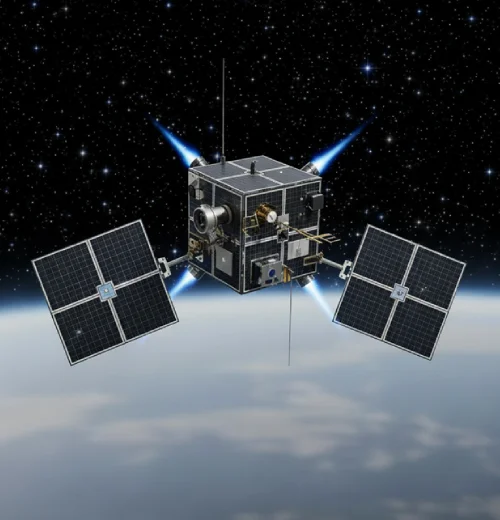
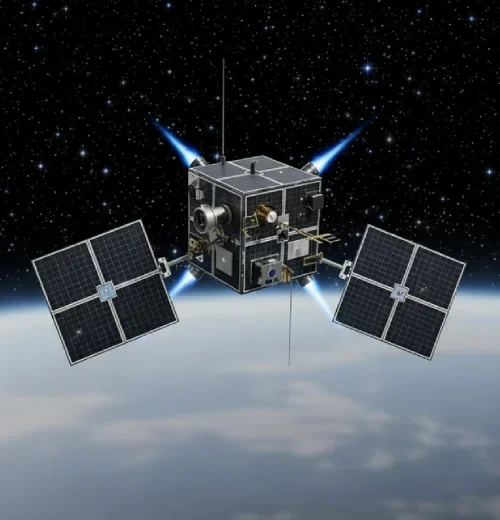
Satellite Platforms LEO Microsatellites
Satellite Platforms (LEO & Microsatellites)

Satellite Platforms (LEO & Microsatellites)

RSat Space’s satellite platforms for low Earth orbit and microsatellites give defense, government, commercial and research customers a faster, lower-risk path to orbit.

These modular buses support imaging, RF intelligence, secure communications and technology demonstration missions while balancing performance, reliability, launch schedule and lifecycle cost for missions originating from Montréal, Canada and allied markets worldwide.

Montréal-Built LEO Microsatellite Platforms

RSat Space designs small satellite platforms optimized for low Earth orbit in the 10–200 kilogram class, giving mission owners a dependable, configurable microsatellite bus instead of starting from scratch with every new Earth observation or communications mission.

Each platform combines flight-proven subsystems with proprietary control, power and data-handling architectures, reducing risk while keeping room for advanced payloads. Customers gain a stable foundation that scales from single satellites to full constellations without re-architecting the entire system.

Designed For Diverse Mission Profiles

Defense and government users typically need LEO platforms that handle ISR, border surveillance, maritime awareness and critical infrastructure monitoring on tight budgets. We configure our microsatellite buses for electro-optical, infrared and RF payloads tuned to those demanding requirements.

Commercial and civil operators use the same underlying platforms for broadband backhaul, asset tracking, environmental monitoring and technology demonstrations. Mission-unique requirements are handled through modular avionics, power, data and mechanical interfaces rather than risky one-off designs that delay deployment.

From single technology demonstrators to coordinated constellations, RSat Space tailors attitude control, power budgets and data paths to each mission profile, ensuring predictable performance across different inclinations, altitudes and regional coverage patterns in low Earth orbit.

High-Precision Pointing And Stability

Many LEO microsatellites struggle to deliver the pointing stability needed for sub-meter imagery or precise RF geolocation. RSat Space platforms are engineered for fine attitude control with designed pointing performance on the order of a few hundredths of a degree.

This stability supports sharper images, more accurate change detection and cleaner RF signal characterization, especially for defense, security and environmental monitoring missions. Combined with agile slewing, operators can rapidly retask the satellite toward emerging events without sacrificing data quality.

Modular Power And Thermal Architecture

Small satellites are often constrained by limited power and thermal margins, which can throttle payload performance. RSat Space designs its LEO platforms with high-efficiency solar arrays, advanced batteries and AI-assisted power conditioning to support demanding sensors and communications packages.

Thermal control combines nano-structured materials with intelligent software that actively manages heaters, radiators and duty cycles. This approach protects sensitive electronics, extends component lifetimes and maintains consistent performance across day–night cycles and varying pointing conditions in low Earth orbit.

Secure And Resilient LEO Communications

For defense and government programs, secure links are non-negotiable. We equip our LEO platforms with encrypted command and telemetry channels, hardened onboard computers and robust fault-management so operators retain trusted control even in contested or congested radio-frequency environments.

Flexible communications architectures support S-band and X-band links, high-rate downlinks through partner ground networks, and options for inter-satellite connectivity. This lets customers scale from experimental missions to operational constellations while keeping a consistent cybersecurity and data-assurance posture.

Rapid Development And Constellation Scaling

Traditional LEO satellite programs can take three to five years from contract to launch, leaving capabilities outdated before they fly. We combine agile engineering, in-house manufacturing and automation to compress typical mission schedules to roughly twelve to twenty-four months.

Standardized microsatellite buses move from start of assembly to integration-complete in weeks, not years, while payload teams iterate in parallel. This enables faster technology refresh, rapid response missions and phased constellation builds without sacrificing verification and environmental testing rigor.

Operating from Montréal’s aerospace corridor, RSat Space supports customers across Canada, the United States, Europe and Asia, coordinating closely with launch providers so LEO platforms are not only built quickly but also aligned with realistic, timely launch opportunities.

Integrated Payload And Bus Engineering

Many LEO missions stall when separate payload and platform suppliers struggle to integrate their systems. RSat Space develops payloads and satellite buses together, aligning mechanical, electrical and data interfaces from day one to reduce schedule risk and interface mismatches.

Electro-optical, infrared, RF and signals-intelligence payloads are designed around the hosting microsatellite’s power, pointing and data budgets. This co-design approach squeezes maximum performance from each kilogram on orbit instead of forcing payloads into unsuitable, off-the-shelf platforms.

Some customers operate their own spacecraft, while others rely on RSat Space to deliver data and intelligence as a managed service. In both cases, tightly integrated LEO platforms simplify operations, validation and long-term maintenance across the mission lifecycle.

Launch-Ready LEO Platform Configurations

RSat Space’s LEO platforms cover nanosatellite, CubeSat and larger microsatellite configurations, sized to match popular rideshare and dedicated small-launcher capabilities. Standard separation systems and mechanical envelopes simplify integration with multiple launch providers and reduce non-recurring engineering effort.

For missions targeting specialized inclinations or altitudes, the platforms are compatible with orbital transfer solutions, enabling deployment into precise low Earth orbits even when starting from shared rideshare drops. This flexibility helps protect coverage, latency and overflight requirements.

Responsible And Sustainable LEO Operations

Low Earth orbit is increasingly crowded, and many regulators now expect satellites to deorbit within roughly twenty-five years of mission end. RSat Space designs its platforms with propulsion, drag and end-of-life strategies that support responsible space operations.

Mission concepts incorporate collision-avoidance considerations, tracking support and graveyard-orbit or deorbit plans where appropriate. This approach reduces long-term debris risk and aligns LEO platforms with emerging global best practices for sustainable, transparent use of orbital infrastructure.

Enabling Multi-Domain Mission Effects

Modern defense and civil security missions rarely rely on space assets alone. We design our LEO microsatellite platforms to plug into multi-domain architectures that connect satellites with airborne ISR, ground forces, maritime assets and cyber-defense systems.

Open, standards-aligned interfaces, secure networking options and onboard processing make it easier to fuse satellite data with other sensors and decision-support tools. Customers gain a more complete operational picture without designing custom platforms for every new multi-domain concept.

whatsapp-2.png
Phone Number
+1 514-399-1097
Office-Location-Image.png
Business Location
2329 Guenette St, Montreal, Quebec H4R 2E9, Canada

Key Questions On LEO Platforms

Who are your LEO platforms for?

Our low Earth orbit satellite platforms are designed for defense agencies, government programs, commercial operators and research institutions that need reliable microsatellites without waiting five to seven years. RSat Space supports missions from Montréal and across allied markets that require imaging, RF intelligence, secure communications or technology demonstration in responsive, affordable LEO orbits.

How fast can you deliver LEO satellites?

Because RSat Space combines in-house payload development with agile manufacturing, typical LEO missions move from contract to launch in roughly twelve to twenty-four months, depending on complexity. For urgent low Earth orbit programs, we can further compress schedules while still performing full environmental testing and qualification on the microsatellite platform and payload.

What performance can your microsatellite platforms support?

Our microsatellite platforms in low Earth orbit are engineered for high-precision pointing, stable power and robust data handling. That means they can support sub-meter imaging payloads, advanced RF and SIGINT sensors, secure communications packages, or mixed missions where multiple instruments share the same LEO bus without compromising performance or reliability.

Can you provide turnkey mission delivery in Canada?

Yes, RSat Space regularly delivers turnkey LEO satellite missions from Montréal for Canadian and international customers. We handle mission design, satellite manufacturing, integration, testing, launch coordination and early operations so you receive a fully qualified low Earth orbit platform, with training and documentation for your in-house or outsourced operations teams.

How do you handle launch and orbit access?

LEO missions benefit from RSat Space’s relationships with major launch providers and rideshare brokers. We size our microsatellite platforms to fit common launch interfaces, then secure suitable flights and manage technical coordination. Where required, we can support orbital transfer solutions to place your satellite into the precise low Earth orbit your concept needs.

How secure are RSat Space LEO missions?

Security is a core design principle for every RSat Space LEO satellite platform. We implement encrypted command and telemetry links, hardened onboard computers, robust fault management and secure ground interfaces, giving defense, government and commercial customers confidence that their low Earth orbit assets, data and operations remain protected throughout the mission.

Do you support technology demonstration and research payloads?

Yes, our LEO and microsatellite platforms are ideal for technology demonstration and research payloads. RSat Space works closely with universities, laboratories and innovation programs to integrate experimental instruments, provide flexible data interfaces and design realistic test campaigns, so new sensors, AI algorithms and communications concepts can be validated quickly in low Earth orbit.

Why Choose Us for Satellite Platforms (LEO & Microsatellites)

Choosing a partner for LEO satellite platforms is ultimately about trust in engineering, schedule and long-term support. RSat Space combines deep space and defense experience with a focused portfolio of low Earth orbit and microsatellite platforms that are built specifically to close real mission gaps, not just demonstrate technology. Customers gain a practical path from first discussion to on-orbit capability without navigating a maze of generic offerings.

For each LEO or microsatellite project, we begin with a mission-architecture dialogue rather than a catalogue sale. Our engineers work directly with your technical and program teams to refine coverage, latency, data volume and security requirements, then translate them into a concrete platform configuration. This collaborative design approach, supported by modelling and simulation, reduces unpleasant surprises later in the program and anchors every decision in measurable performance.

RSat Space also offers a level of transparency and accessibility that is hard to find with large primes. Key engineers remain engaged from concept through launch and early operations, providing clear updates on technical risks, test results and schedule milestones. When issues arise, you are speaking with the people who design and build the LEO satellite platform, not just an intermediary, which accelerates problem-solving.

Being based in Montréal, Canada, RSat Space operates within a trusted regulatory environment that is attractive for allied defense and government customers. Our work is structured around rigorous quality and export-control processes, and that discipline flows into our low Earth orbit products. For missions that must remain discrete or classified, we can align development, documentation and data-handling practices with your security frameworks while still maintaining agile delivery timelines.

Another reason to choose RSat Space is our focus on lifecycle value rather than just launch day. LEO and microsatellite platforms are configured with future upgrades, constellation growth and sustainment in mind, so you can add new payloads, introduce refreshed sensors or scale to additional satellites without throwing away the original design work. Training, documentation and knowledge transfer are built into every project so your teams become more capable with each mission.

Finally, RSat Space designs low Earth orbit platforms as part of a multi-domain ecosystem, not as isolated assets. Our satellites are prepared to interface with airborne ISR, maritime and ground systems, and advanced analytics environments, helping you turn raw LEO data into actionable intelligence. If you are looking for a partner that treats LEO and microsatellite platforms as strategic infrastructure rather than one-off experiments, RSat Space is structured to support that vision.

Clients-Award.png
Happy Customers

Read Reviews...

Plan Your LEO Mission

Share a few details about your low Earth orbit or microsatellite mission and a member of the RSat Space team will contact you to discuss options. Whether you are planning a first LEO satellite, scaling a constellation or exploring ISR and communications concepts, simply complete the form and we will help determine the right platform, schedule and approach for your program.