
Frequently Asked Questions
Can you support sensitive defense space missions?
Yes, we are built to support sensitive and defense-oriented space missions. We have experience working with national defense agencies and security organizations under strict confidentiality, operating within Canadian export control and Controlled Goods frameworks and aligning with ITAR and other international requirements as needed. For these customers we form small, highly trusted engineering teams, use secure communication channels, and tailor our processes to classified or restricted programs so you can discuss requirements openly while maintaining appropriate security. The result is that you get a responsive, technically strong partner who understands both the operational urgency and the confidentiality expectations of defense space projects.
Do you work with commercial customers too?
We work extensively with commercial customers in telecommunications, data services, infrastructure monitoring and other sectors alongside our defense and government projects. For commercial operators we focus on cost-effective GEO communications satellites, smallsat constellations for data and imaging, and remote-sensing-as-a-service models where you buy guaranteed data and analytics instead of owning satellites. Our approach is to reuse the same high-end technology and processes developed for demanding defense missions and adapt them to commercial timelines and business cases, helping you get to market earlier with more differentiated services.
How custom can you make my satellite?
We expect every serious mission to be custom to some degree, and our business is built around tailoring satellites and payloads to your exact objectives. Under the hood we use modular bus platforms, payload building blocks and qualified subsystems so we do not reinvent what already works, but we adjust payload configuration, orbital regime, power, data handling, propulsion, autonomy and integration with your ground or existing systems to match your concept of operations. Whether you need a one-off pathfinder, a small constellation, a GEO communications platform or a specialized ISR asset, we shape the architecture around your performance, schedule, security and budget constraints rather than forcing you into a one-size-fits-all product.
Where are you based and operating globally?
We are headquartered in Montréal, Canada, within an established aerospace and technology corridor, and we support customers across North America, Europe and Asia from this base. We maintain additional presence in key international hubs such as the United Kingdom and selected Asian markets, and we are actively planning a dedicated U.S. headquarters and manufacturing hub to serve American defense, government and commercial customers with locally built, ITAR-aligned systems. This growing footprint lets us collaborate closely with leading research institutes and industrial partners while staying available across time zones for your program needs.
What makes your GEO smallsats unique?
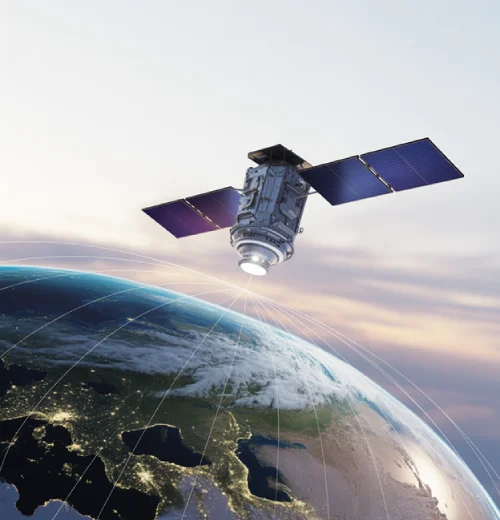
Our GEO-capable small satellite platform, the Sigma Series, brings capabilities traditionally reserved for large, multi-ton GEO spacecraft into a microsatellite-class bus of roughly 60–120 kilograms. Sigma is designed to support substantial payload power, long-life station-keeping, advanced radiation protection and AI-driven operations in geostationary orbit, enabling missions such as communications, ISR, early-warning and SIGINT from GEO at a fraction of the mass and cost of conventional platforms. We combine efficient propulsion, nano-structured shielding, high-efficiency power systems and proprietary autonomy software so you can consider GEO architectures that were previously financially or logistically out of reach, or build multi-satellite GEO systems instead of committing to a single large spacecraft.
How do you handle launch arrangements?
We actively manage launch planning as part of your mission, so you do not have to navigate the launch market alone. We maintain relationships with major launch providers and rideshare brokers, allowing us to secure low Earth orbit and, via direct injection or orbital transfer vehicles, GEO and higher orbital opportunities on realistic timelines. During your project we match the satellite configuration and target orbit to suitable upcoming launches, manage technical interfaces and documentation, and coordinate readiness so that once your satellite is qualified it is not left waiting years for a rocket. This integrated approach to launch planning is a major reason we can turn satellites into operational systems quickly.
How secure is my mission data?
We treat mission data and communications security as core design requirements from the beginning of each project. Architectures typically include encryption for command and telemetry links, secure handling of payload data end-to-end, and design choices that can support anti-jam and low-probability-of-intercept characteristics where defense or critical infrastructure customers require them. On the ground, we apply strict access control, secure development and operational processes, and, where needed, work with customer or partner facilities to ensure data stays within specific jurisdictions or classified environments. Our goal is that you can trust not just the hardware in orbit, but the confidentiality, integrity and availability of the data it produces.
Do you only sell complete satellites, or can I buy components?
We no longer position ourselves as a component supplier and instead focus on complete, integrated systems. While we design and build high-performance internal components such as RF front-ends, antennas, sensors and propulsion subsystems, these are used within our own payloads and satellite buses so we can control performance, schedule and quality at the system level. If you work with us, you engage us as a turnkey mission partner delivering satellites, payload suites and, where desired, ground and data services, rather than purchasing individual off-the-shelf parts.
What is your typical project timeline end-to-end?
A typical project begins with a concept and requirements definition phase, during which we work with you to refine mission objectives, orbital needs, payload characteristics, interfaces, regulatory constraints and budget. This evolves into detailed design, manufacturing, integration and environmental testing, followed by launch campaign support and on-orbit commissioning. For many missions this full cycle fits into a 12–24 month window, with simpler or prototype missions sometimes completing on the shorter side and more complex, multi-satellite or highly classified programs trending toward the longer end. Throughout, we focus on maintaining clear milestones, regular technical reviews and transparent schedule management so you always understand where your mission stands and what decisions are coming next.
How do you work with highly classified or sensitive customers?
For classified, intelligence or other sensitive customers we tailor both organizational and technical measures to the security level required. That may include restricted-access engineering cells, secure networks, controlled documentation handling, and alignment with your national processes for security accreditation and program oversight. Our location in Canada and experience with controlled goods and export frameworks help us navigate multi-national arrangements where allied partners are involved. The practical result for you is that we can discuss operational scenarios, threats, and constraints candidly and build systems that respect classification boundaries without compromising technical performance or schedule.
We have never flown a satellite before. Can you guide us through everything?
Yes, many of our customers are first-time or infrequent satellite operators, and we are comfortable guiding you through every phase of the journey. We begin by helping you translate high-level goals into a realistic mission concept, then walk you through trade-offs between orbit choices, payload options, platform sizes, budgets and timelines. During development we explain technical decisions in accessible terms, involve your team in design reviews at appropriate depth, and support regulatory filings where applicable. As launch approaches, we help you understand campaign activities and risk management, and once on orbit we can operate the satellite on your behalf or train your staff to take over. Our aim is to make advanced space capability accessible, even if you are new to it.
How do you help telecom operators and broadband providers?
For telecom and broadband customers we focus on delivering GEO communications satellites and smallsat-based architectures that are significantly more efficient and flexible than traditional large GEO platforms. Using our Sigma-class GEO smallsats or other appropriate buses, we can design payloads that provide regional coverage, targeted capacity for underserved areas, or specialized services without the capital burden of a multi-ton satellite. We pay particular attention to link budgets, coverage footprints, interference environments and regulatory considerations, and we build the solution so it can integrate with your existing terrestrial networks and operations. This allows you to extend service reach, add redundancy or launch new offerings with a faster path to revenue.
What is the Sigma Series status today?
The Sigma Series GEO small satellite platform is one of our flagship developments and is in advanced stages of qualification and integration. Key subsystems such as propulsion, power, structures, thermal management and onboard computing have undergone extensive ground testing in simulated space environments, and the first Sigma-class buses are progressing through integration and verification. While Sigma is an emerging product family rather than a decades-old legacy bus, many of its building blocks are derived from technologies already proven in orbit on our other missions, and its design has been shaped by real customer requirements for affordable, agile GEO missions. We are transparent about the maturity of each element and work with you to match platform readiness to mission criticality.
Can you provide remote sensing and ISR as a service?
Yes, if you prefer not to own or operate satellites, we can provide remote sensing and ISR as a service. In this model you define the geographic areas, phenomena or mission types you care about, and we handle tasking, collection, processing, analytics and secure delivery of finished products or tailored data feeds. The underlying space assets may be satellites we build and operate ourselves or systems we integrate with, but you interact mainly with a service interface and agreed performance metrics. This approach is particularly attractive for defense, government and commercial users who need reliable, high-quality space-derived intelligence but want to minimize capital expenditure, technical risk and the need to build their own space operations team.
How do you integrate space with air, land, sea and cyber operations?
From the outset we design our solutions to contribute to multi-domain operations rather than treating satellites as isolated assets. That means we think carefully about how space-based sensors and communications interact with airborne ISR platforms, ground forces, maritime security systems and cyber infrastructures. Architecturally, we support standardized and secure data interfaces, real-time or near-real-time tasking, and fusion of optical, infrared, radar and RF intelligence into joint operating pictures. On the technology side, our work in robotics, ground-based RF systems and autonomous platforms complements what happens in orbit, allowing you to build integrated concepts of operation that span space, air, land, sea and cyber domains.
How do you handle launch schedule risk for my mission?
Launch schedule risk is a real factor in any space program, and we address it by planning for flexibility rather than committing you to a single narrow opportunity. Because we work with multiple launch providers and brokers, we can map your required orbit and mass to several potential launch options and plan for alternates where feasible. During development we track vehicle manifests, adjust readiness dates where appropriate and keep you informed of any emerging changes in the launch market that might influence timing. When schedule is critical, we may design the satellite to be compatible with more than one launcher or consider combinations of rideshare and orbital transfer to achieve your target orbit, always balancing risk, cost and performance.
What propulsion technologies do you develop and why does that matter?
We develop and integrate advanced electric propulsion systems, including Hall-effect thrusters and related subsystems, as well as exploring green monopropellant options for missions that require higher-thrust maneuvers. These propulsion capabilities enable efficient orbit-raising, precise station-keeping, on-demand relocation between orbits and responsible end-of-life de-orbiting or graveyard disposal. For you as a customer, that translates into more flexible mission designs, longer operational lifetimes for a given propellant load, and the ability to adjust your space assets as strategic or commercial needs evolve rather than being locked into a single orbit forever.
How accurate is your pointing and why does it matter?
Our microsatellites are engineered for very high pointing stability and accuracy, significantly better than what is common in similar size classes. We achieve this through a combination of precise attitude sensors, advanced control algorithms and carefully designed actuation systems, all tuned and verified during integration and testing. For imaging and ISR missions, this means sharper images, more reliable target tracking and better revisit performance; for communications and RF missions, it means more stable links and tighter, more efficient beams. In practice, high pointing performance gives you more usable information per pass, more consistent data quality and better utilization of your payload investment.
Who owns the data and intellectual property from my mission?
We treat ownership of mission data and intellectual property as an important contractual topic from the beginning. In most customer missions, you retain ownership of the operational data generated by your satellite and any unique application-level IP that arises from how you use that data, while we retain ownership of our underlying platform technologies, generic software and reusable building blocks. For remote-sensing-as-a-service models, we define specific rights around tasking, data access and sharing. Our goal is to give you clear control over the strategic assets you care about while allowing us to continue investing in and improving the core technologies that benefit all customers.
How do you ensure quality, testing and reliability?
Quality and reliability are built into our processes from early design through to on-orbit operations. We follow ISO-aligned quality management practices with formal design reviews, configuration control, risk tracking and continuous improvement, even as we work toward full certification. Every satellite and payload undergoes rigorous environmental testing, including vibration, thermal vacuum and electromagnetic compatibility testing, as well as functional and performance verification at subsystem and system levels. Our engineers draw on prior flight experience and long careers in aerospace to design with margins and failure modes in mind, and we work closely with launch providers and customers to ensure that interfaces, safety requirements and operational procedures are fully validated before flight.
How do you comply with export controls and security regulations?
As a Canadian about-rsat-space operating in defense and dual-use space technologies, we comply with the Canadian Controlled Goods Program and relevant export control regulations, and we are experienced in working within ITAR and EAR contexts when projects involve U.S. or other regulated technologies. Practically, this means we assess each mission’s regulatory landscape early, structure contractual and technical arrangements accordingly, and coordinate with your compliance teams to ensure hardware, software, data and personnel flows remain lawful and controlled. This disciplined approach reduces the risk of surprises later in the project and gives you confidence that your mission is being executed with full respect for national and international regulations.
We are an academic or research institution. Can you support a smaller demonstration mission?
Yes, we regularly work with universities, research labs and consortia on technology demonstration and scientific missions. For these customers we often emphasize flexible, modular platforms that can host experimental payloads, as well as support for research-driven schedules, collaborative development and knowledge transfer. We can help you scope a mission that fits academic budgets while still leveraging our advanced technologies in areas like imaging, RF sensing, propulsion or autonomy. Beyond the mission itself, we value ongoing relationships with academia, including joint R&D initiatives and opportunities for students and researchers to engage with real flight hardware.
What types of customers are the best fit for you?
The best fit customers for us are organizations that need high-performance, mission-specific space capability and value speed, innovation and technical depth. This includes defense and national security agencies seeking ISR, secure communications or space domain awareness; telecom and data service providers pursuing GEO or smallsat-based offerings; civil government bodies responsible for environmental monitoring, border security or critical infrastructure; and research institutions pursuing frontier technologies. If you have a serious mission concept, are ready to engage in a collaborative technical dialogue, and want a partner who can take responsibility for the full space segment, we are likely a strong match.
How do you price missions and what budget ranges can you support?
Mission pricing depends on many factors, including orbit, payload complexity, platform class, level of redundancy, security requirements, ground segment needs and whether you are buying satellites, data services or a combination. Early in discussions we work with you to estimate an appropriate budget envelope and show how design choices influence cost, so you can prioritize what matters most. Because we use agile manufacturing, modular designs and in-house payload development, we can often deliver capabilities more cost-effectively than traditional large primes, particularly for small GEO, microsatellite constellations and specialized ISR missions. Our goal is to build a technically sound, financially clear proposal that aligns with your program constraints.
Do you offer ground segment, mission control and data services?
Yes, we can provide everything from basic TT&C capabilities through to full mission control centres and integrated data processing chains. Depending on your needs, we may design and deploy dedicated ground infrastructure for you, integrate with trusted partner ground station networks, or operate the ground segment as a managed service. On the data side, we can build pipelines that ingest raw satellite data, perform calibration and processing, apply AI-driven analytics such as change detection or target recognition, and deliver finished products via secure interfaces. This allows you to choose whether you want a self-operated ground segment, an outsourced solution or a hybrid approach.
How do you support operations after launch?
After launch we typically support or lead the commissioning phase, during which we verify satellite health, deploy systems, validate payload performance and transition into routine operations. For some customers we continue to operate the satellite day-to-day from our control facilities or from joint centres, handling tasking, monitoring, anomaly resolution and software updates. For others we train your team, provide operational procedures and tools, and stand behind you as an escalation partner for complex issues. Throughout the mission life we monitor performance, look for opportunities to optimize operations, and support end-of-life maneuvers to ensure responsible disposal when the mission concludes.
What is your approach to sustainable and responsible space operations?
We design missions with space sustainability in mind from the outset. That includes planning de-orbit or transfer to graveyard orbits, using propulsion and mission profiles that avoid leaving uncontrolled objects in congested regions, and supporting emerging best practices in space traffic management and conjunction analysis. On Earth, we incorporate sustainability considerations into our facilities and manufacturing processes where feasible and encourage internal initiatives around efficient resource use. We also view education and outreach as part of responsible operations, with our engineers engaging in STEM programs, conferences and collaborations to help build a space sector that grows in a safe, thoughtful and inclusive way.
Can we visit your facilities or meet your team?
In many cases, yes, we welcome customer visits and technical workshops at our Montréal facility or at appropriate partner locations, subject to security and export control considerations. Early in a relationship, in-person sessions can be very valuable for aligning expectations, reviewing hardware, and building mutual trust between your team and ours. For highly sensitive programs, visits and interactions are coordinated to match the security posture required, which may involve restricted access zones and pre-clearance. We also regularly meet customers at major aerospace and defense events worldwide, where we can explore opportunities and follow up with deeper technical sessions.
How do I start a conversation about a potential project with you?
The simplest way to start is to contact us by email or phone with a short description of your organization, mission idea, timeline and constraints. From there we usually set up an initial technical and commercial discussion to understand your goals, ask clarifying questions and share preliminary thoughts on possible architectures and approaches. If there is a good fit, we move into more detailed mission studies and proposal development, always aiming to give you clear information on capabilities, schedules, risks, and costs. Whether you are a defense agency with an urgent requirement, a telecom operator exploring GEO smallsats, a government program office, or a research group with an ambitious concept, we are ready to help you turn that idea into a concrete, executable mission plan.
Have a Question We Haven’t Covered?
Didn’t find what you were looking for? Send us your question using the form below, and our team will get back to you with the right information and guidance.