
Propulsion Orbital Transfer Vehicles OTVs
Propulsion & Orbital Transfer Vehicles (OTVs)

Robotics & Autonomous Systems

RSat Space’s Robotics & Autonomous Systems provide mission-ready ground and space platforms that extend our satellite capabilities into complex operational environments.

Based in Montréal, Canada, we design security, inspection, and exploration robots that operate across land, maritime, industrial, and near-space domains, giving defense, government, and critical-infrastructure users persistent, AI-enabled sensing, response, and decision support when human access is risky, slow, or impossible.

Multi-Domain Robotics System Architecture

RSat Space designs robotics and autonomous systems as part of a unified multi-domain architecture linking space, air, land, sea, and cyber assets. Each robot is a forward sensor and effector, extending satellite intelligence into complex, contested, or remote environments.

This architecture gives mission owners consistent interfaces across satellites, UAVs, and ground robots. Planners reuse a common autonomy stack and security layer, reducing integration risk and accelerating deployment of new robotic capabilities in Montréal, across Canada, and other allied markets.

Autonomous Perimeter And Infrastructure Security

Autonomous security robots from RSat Space patrol borders, bases, industrial zones, and critical infrastructure where human guards face fatigue, blind spots, or safety risks. Sensors, cameras, and RF payloads deliver continuous, high-resolution awareness around facilities on land and near coastlines.

AI-enabled autonomy plans routes, avoids obstacles, and flags anomalies such as intrusions, loitering vehicles, or tampered fences. Data can be fused with satellite imagery, aerial drones, and fixed sensors, giving security teams a consolidated picture instead of siloed camera feeds.

Robots are ruggedized for Canadian winters and harsh international climates, with weatherproof enclosures, redundant communications, and long-endurance power systems. RSat Space tailors chassis, payloads, and autonomy so bases, airports, seaports, and energy sites can scale security without scaling headcount.

Hazardous And Contaminated Environment Platforms

Many missions involve chemical spills, fire, radiation, unexploded ordnance, or unstable structures where sending people is unacceptable. RSat Space develops tracked and wheeled robots carrying sensors, sampling tools, and manipulators into these hazardous or contaminated environments instead of human teams.

Platforms support remote teleoperation from safe standoff distances and supervised autonomy for routine inspection routes. Defense, civil protection, and industrial operators can rapidly assess scenes, capture measurements, and intervene while keeping personnel behind secure barriers or command vehicles.

Space Robotics Manipulators And Rovers

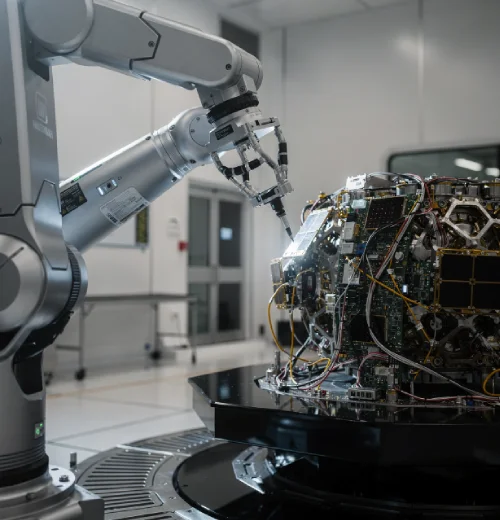
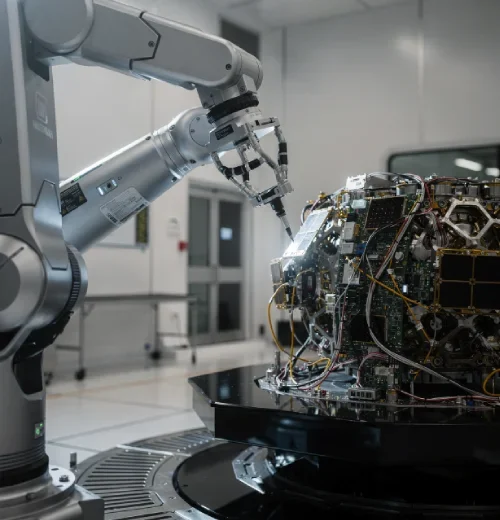
RSat Space extends its robotics expertise into orbit with manipulators, robotic arms, and rover technologies for future on-orbit servicing, inspection, and exploration missions. Lightweight structures and novel micro-actuators enable precise motion control where mass, volume, and power are tightly constrained.

These space robotics systems integrate with RSat Space satellite platforms, supporting inspection of spacecraft, deployment of hosted payloads, and experiments with in-situ assembly or logistics. High-fidelity dynamics models and simulation tools reduce risk before mechanisms ever reach orbit.

Rover concepts are developed for lunar and planetary analog terrains, drawing on experience with space robotics, avionics, and simulation from Montréal’s aerospace ecosystem. Customers planning technology demonstrators or future cislunar logistics can collaborate with RSat Space to shape mission roadmaps.

Integrated ISR Robotics For Defense

Modern defense and national security missions require synchronized ISR across satellites, UAVs, ground patrols, and maritime platforms. RSat Space Robotics & Autonomous Systems add mobile sensing nodes that approach targets, follow routes, or hold positions unreachable or inefficient for patrols.

Robots can host EO/IR cameras, RF direction-finding antennas, acoustic arrays, chemical detectors, or radar modules, sharing data through secure networks into the same ISR cloud as RSat Space satellites. Commanders gain richer awareness without increasing vehicles or operators deployed.

Use cases range from border and coastal security around Montréal and other Canadian regions to expeditionary operations with allied forces. RSat Space configures each ISR robotic solution around mission requirements, regulations, and the terrain, climate, and threat profile involved.

Autonomy Software AI And Control

Reliable autonomy is the heart of RSat Space’s Robotics & Autonomous Systems. Our software stack combines classical control, AI, and machine learning to handle navigation, obstacle avoidance, health monitoring, and task execution while respecting mission rules and safety constraints.

Operators can choose teleoperation, supervised autonomy, or fully autonomous modes depending on risk level and regulatory framework. Interfaces expose clear status indicators and decision logs so defense, civil, and industrial users understand why a robot acted, supporting trust and auditability.

Because RSat Space also builds satellites and ISR payloads, the autonomy layer is designed from the outset to coordinate with space-based assets, enabling tasking from orbit, dynamic retasking based on new imagery, and cross-cueing between robots, drones, and ground sensors.

Simulation Testing And Digital Twins

Before hardware arrives on-site, RSat Space runs extensive simulation campaigns and digital-twin testing for each robotic platform. Terrain, climate, payload mass, and communication latency are modelled so performance in Montréal, Arctic, desert, or maritime environments is predictable instead of experimental.

Digital twins let customers rehearse missions, validate tactics, and test software updates with no risk to fielded equipment. This approach reduces commissioning time, uncovers edge cases earlier, and gives training teams realistic scenarios tied to their exact configuration.

Human-Machine Teaming And Operator Interfaces

Robotics & Autonomous Systems only deliver value when operators can use them confidently under pressure. RSat Space designs control stations, tablets, and wearables presenting maps, video, alerts, and health data in layouts optimized for defense, emergency response, and industrial workflows.

Common interfaces across robots, drones, and satellite tasking reduce training overhead and staffing requirements. Montréal-based customers and international users can start with a small deployment and scale fleets without retraining, because the same user experience carries across domains and platforms.

Lifecycle Support Training And Upgrades

Deploying Robotics & Autonomous Systems is a long-term commitment, so RSat Space supports the full lifecycle from concept through deployment, maintenance, and technology refresh. Engineering teams configure spares, health dashboards, and upgrade paths matching each customer’s mission tempo and budget.

Training programs cover operator skills, basic field maintenance, and cyber hygiene for connected robotic fleets. For Montréal, Canadian, and international customers, RSat Space delivers training on-site or virtually, keeping teams proficient as software evolves and new capabilities roll out.

Responsible And Sustainable Robotics Operations

RSat Space embeds safety, ethics, and sustainability into every Robotics & Autonomous Systems deployment. Designs prioritize fail-safe behaviors, clear human override, and regulatory compliance so defense, civil, and commercial users can field advanced robotics without compromising safety or policy obligations.

Energy-efficient designs, end-of-life strategies, and robust cybersecurity are treated as core requirements rather than extras. Montréal-based engineers work with customer oversight bodies, legal teams, and standards organizations to align RSat Space solutions with evolving guidance on responsible autonomous systems.

whatsapp-2.png
Phone Number
+1 514-399-1097
Office-Location-Image.png
Business Location
2329 Guenette St, Montreal, Quebec H4R 2E9, Canada

Robotics & Autonomous Systems Insights

What Robotics Platforms Does RSat Space Provide?

RSat Space develops Robotics & Autonomous Systems spanning autonomous security robots, hazardous-environment inspection platforms, maritime and perimeter patrol units, and space robotics such as manipulators and rover concepts. Each platform is engineered to integrate with our satellites, ISR payloads, and ground segment so customers receive a coordinated, multi-domain robotics capability rather than stand-alone machines.

How Do Your Robots Support Defense Missions?

Our Robotics & Autonomous Systems extend ISR, force protection, and base security operations by carrying EO/IR, RF, radar, and CBRN sensors directly to the point of interest. Robots can patrol borders, secure perimeters, assess threats, and share data with RSat Space satellites and command systems, giving defense users persistent, layered awareness without exposing personnel to unnecessary risk.

Can Systems Operate In Harsh Canadian Conditions?

Yes. Robotics & Autonomous Systems are designed for extreme climates, including Montréal winters, coastal environments, and hot, dusty theatres abroad. We engineer enclosures, mobility, and power systems for snow, ice, rain, and heat, then validate performance through digital-twin simulation and environmental testing so your robotics fleet remains dependable in real-world conditions, not just laboratory trials.

How Secure Are Your Autonomous Systems?

Cybersecurity is treated as a core requirement for every Robotics & Autonomous Systems deployment. RSat Space uses encrypted links, hardening, and strict access control aligned with defense and government expectations. Autonomy software is designed with fail-safe behaviours, audit logs, and clear human override so mission owners retain control while benefiting from AI-enabled robotics and multi-domain connectivity.

What Is A Typical Deployment Timeline?

Timelines depend on mission complexity, but RSat Space’s robotics engineering model emphasizes rapid deployment. For many Robotics & Autonomous Systems projects, we move from design to demonstration in months, not years, using simulation, modular hardware, and proven autonomy software. This approach lets customers validate concepts quickly, refine requirements, and scale fleets with reduced schedule and integration risk.

Do You Offer Custom Robotics Engineering?

RSat Space specializes in tailoring Robotics & Autonomous Systems to specific defense, government, and industrial missions. We can adapt chassis, payloads, autonomy levels, and interfaces to your terrain, regulations, and existing infrastructure. Whether you need a small inspection robot, a perimeter security fleet, or space robotics integrated with satellites, we design against your operational concept, not generic templates.

Why Choose Us for Robotics & Autonomous Systems

Choosing RSat Space for Robotics & Autonomous Systems means working with a partner that designs robotics as part of a complete mission architecture, not as isolated gadgets. Our teams understand how robots, satellites, UAVs, and ground systems must interoperate across space, air, land, sea, and cyber domains to deliver timely intelligence and effect.

We bring deep aerospace and defense heritage into every robotics project, combining advanced actuators, lightweight structures, and high-fidelity simulation with AI-enabled autonomy and secure communications. This engineering depth allows us to configure platforms for perimeter security, hazardous environments, maritime awareness, or space robotics while keeping reliability and maintainability at the centre of each design.

RSat Space operates from Montréal within a trusted Canadian regulatory framework, experienced in controlled goods and export-control compliance. That foundation is crucial for defense and government users who need Robotics & Autonomous Systems that respect security, privacy, and policy constraints while still delivering modern autonomous capabilities and multi-domain connectivity.

Our approach is highly collaborative. We begin with mission analysis, terrain and threat assessments, and stakeholder workshops, then translate those insights into tailored Robotics & Autonomous Systems roadmaps. Customers see early value through simulations and prototypes, reducing program risk and ensuring the final deployment matches real operational needs rather than assumptions captured years earlier.

Because RSat Space also designs satellites, payloads, propulsion, and ground segments, we offer a single point of accountability for robotics integrated with space-based services. Data flows, tasking, and command-and-control are designed together, giving program managers clearer ownership, fewer integration seams, and a coherent path to scaling Robotics & Autonomous Systems fleets over time.

Finally, we prioritize sustainability, safety, and responsible autonomy in every deployment. From fail-safe behaviours and human override mechanisms to energy-efficient designs and lifecycle planning, RSat Space ensures Robotics & Autonomous Systems enhance your mission while aligning with evolving standards for ethical and secure use of autonomous technologies.

Clients-Award.png
Happy Customers

Read Reviews...

Discuss Your Robotics Mission

Ready to explore Robotics & Autonomous Systems tailored to your mission? Share a few details in the form and RSat Space will connect you with a specialist. We can discuss threats, terrains, climates, and timelines, then design a robotics concept, demonstration, or deployment that fits your Montréal, Canadian, or international operations and delivers reliable, actionable results. Please use the form to get started today.