
Mission Design System Engineering
Mission Design & System Engineering

Mission Design & System Engineering

RSat Space provides mission design and system engineering services that transform satellite and multi-domain ideas into executable space missions.

From Montréal, Quebec, we support defense, government, commercial and research organizations, turning complex objectives, constraints and risks into clear architectures, validated requirements and realistic implementation roadmaps that connect early studies to launch, operations and data delivery.

End-To-End Mission Architecture Design

RSat Space begins mission design by turning high-level objectives into a clear concept of operations and complete mission architecture. We map space, ground and user segments, so every interface and data path supports how customers actually operate and make decisions.

Many teams struggle to connect strategic intent with technical choices. Our architects work directly with defense, government, commercial and research stakeholders to refine use cases, coverage needs and success criteria, avoiding rework and ensuring the space system meets the mission.

Requirements Capture And Trade Studies

Unclear or conflicting requirements are one of the biggest causes of overruns in satellite missions. RSat Space leads structured requirements workshops, consolidating stakeholder inputs into traceable, testable specifications that align performance, cost, schedule and regulatory expectations from the outset.

We conduct detailed trade studies on orbits, payload configurations, launch options, redundancy strategies and ground architectures. Our engineers compare alternatives using analytical tools and simulation, quantifying how each choice influences capability, risk and lifecycle cost before decisions are locked in.

This disciplined systems engineering approach prevents scope creep and late design changes that commonly add years to programs. Customers receive recommendations backed by transparent data and assumptions, supporting confident approvals by technical authorities, procurement boards and senior decision-makers.

Systems Engineering And MBSE Frameworks

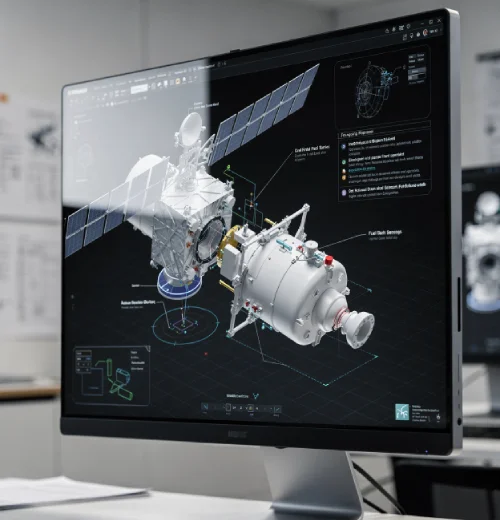
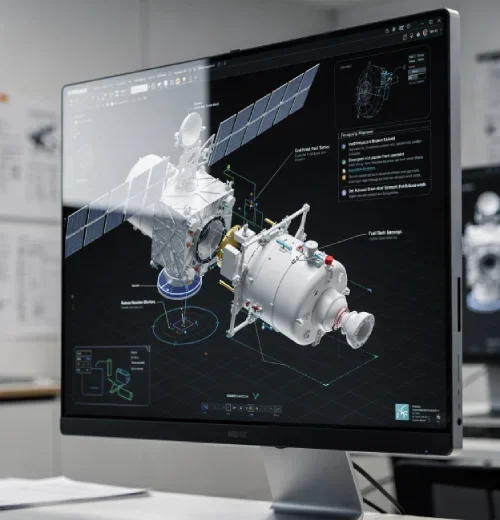
RSat Space applies modern systems engineering practices, including model-based systems engineering, to manage complexity across the mission lifecycle. We maintain a digital thread linking requirements, design models, analyses, tests and operational procedures for every satellite or multi-domain architecture.

Without a coherent framework, documentation fragments and suppliers diverge. Our MBSE approach gives program managers and reviewers a living, visual representation of the system, reducing ambiguity, simplifying design reviews and providing a strong foundation for configuration control and safety assessments.

By combining disciplined systems engineering with agile iteration, RSat Space keeps missions moving quickly while preserving traceability. This balance is essential for defense and government programs that demand strict governance yet must respond to evolving operational scenarios and emerging threats.

Payload, Bus And Ground Integration

Integrating payloads, satellite buses and ground systems is where many programs encounter delay and risk. RSat Space defines end-to-end electrical, mechanical and data interfaces early, ensuring every subsystem can communicate and operate together long before hardware enters the Montréal cleanroom.

We coordinate with payload providers, launch integrators, ground-station networks and operations teams to harmonize protocols, bandwidth, pointing requirements and calibration concepts. This integration focus minimizes test-campaign surprises and supports a smooth transition from engineering models to flight-ready configurations.

When customers use RSat Space’s own satellite platforms, integration benefits from standardized interfaces and in-house payload development. That reduces dependence on third parties, shortens troubleshooting loops and helps achieve the compressed schedules our teams are known for delivering.

Orbit, Coverage And Constellation Analysis

Choosing the right orbit is fundamental to space mission design. RSat Space evaluates regimes from low Earth orbit to GEO, assessing visibility, latency, revisit time, radiation environment and propulsion needs in line with each customer’s priorities and risk appetite.

Our specialists model single satellites and constellations, studying coverage gaps, dwell times, contact windows and handover strategies. We also perform capacity and availability analyses for communications missions, and optimize ground tracks for persistent remote-sensing over borders, infrastructure or maritime corridors.

Customers gain clear, quantitative justifications for orbit and constellation choices, supporting internal reviews and regulatory coordination. These studies are documented for future reuse, so follow-on missions can leverage prior work rather than repeating expensive analyses from scratch.

Performance, Cost And Schedule Optimization

Balancing performance, budget and delivery time is one of the hardest aspects of mission design and system engineering. RSat Space quantifies trade-offs between payload capability, redundancy, launch mass and schedule, helping organizations select configurations that meet operational needs without over-designing.

We use parametric models, cost databases and experience from previous programs to forecast lifecycle cost, from development through operations and disposal. This enables realistic planning, credible business cases and funding approvals grounded in transparent, technically defensible assumptions.

Because RSat Space also designs and builds satellites, our engineers understand how mission-level decisions affect manufacturing, integration and test campaigns. That practical insight feeds into system engineering, reducing schedule risk and improving predictability for defense, government and commercial satellite programs.

Space, Regulatory And Security Compliance

Many organizations underestimate how regulatory and security constraints shape space mission design. RSat Space weaves export controls, spectrum licensing, debris-mitigation policies and national security considerations into requirements and architectures from the beginning, rather than treating them as late paperwork.

Operating from Canada, we align mission designs with applicable Canadian frameworks and international obligations, while supporting customers in other jurisdictions through coordinated compliance planning. This includes secure data architectures and classification-aware design for defense and national security missions.

By treating security and compliance as core design drivers, RSat Space helps customers reduce approval risk, demonstrate responsible stewardship of orbits and data, and build confidence with oversight bodies, launch providers and international partners.

Risk, Reliability And Design Margins

Even compact satellites require careful reliability engineering. We carry out structured risk assessments, failure-mode analyses and fault-tree reviews to identify weak points early, then define design margins, redundancy schemes and contingency operations tailored to each mission’s criticality and budget.

RSat Space incorporates lessons from prior on-orbit performance, environmental tests and anomaly investigations into every new mission design. This feedback loop strengthens engineering baselines and gives customers confidence that risk-mitigation strategies are grounded in operational experience, not just theoretical models.

For high-importance defense or national-security missions, RSat Space can implement enhanced assurance measures, including design-to-survive strategies, graceful degradation concepts and advanced health monitoring, always balancing survivability benefits against mass, power and schedule impacts.

Multi-Domain Mission Concepts Development

Modern defense and security missions rarely operate in space alone. RSat Space designs mission concepts that combine satellites with air, land, maritime and cyber capabilities, ensuring the space segment supports truly multi-domain operations rather than isolated data products.

We work with operators to define cross-domain use cases, data flows and response timelines, then translate them into system-level requirements. This ensures mission design and system engineering are directly tied to decision-making and outcomes, not just technical specifications.

By considering multi-domain effects from the earliest phases, RSat Space helps organizations avoid stovepiped investments, reuse existing assets more effectively and lay the groundwork for future autonomous, AI-enabled coordination between platforms.

Prototyping, Simulation And Digital Twins

To de-risk complex missions, RSat Space uses prototyping, high-fidelity simulation and emerging digital-twin practices throughout mission design and system engineering. Concepts are validated in software and hardware-in-the-loop environments before designs are frozen or major procurement decisions are made.

Customers gain early insight into sensor performance, autonomy behaviour, ground workflows and operator workload, allowing refinements while changes remain affordable. This iterative validation shortens commissioning phases and improves the likelihood that the deployed system behaves as expected from day one.

Because RSat Space combines mission design with manufacturing and environmental testing, insights from prototypes feed directly into engineering drawings, integration procedures and operational playbooks, tightening the loop between analysis and reality for Montréal and international missions.

whatsapp-2.png
Phone Number
+1 514-399-1097
Office-Location-Image.png
Business Location
2329 Guenette St, Montreal, Quebec H4R 2E9, Canada

Turnkey Mission Delivery Answers

What Does Turnkey Mission Delivery Include?

RSat Space’s turnkey mission delivery covers mission studies, satellite platform and payload design, manufacturing, testing, launch coordination, ground segment implementation, and on-orbit operations.

Who Is End To End Delivery For?

End-to-end mission delivery is ideal for organizations that need satellite capability but cannot maintain a large internal space team. Defense agencies, civil government programs, telecom operators, infrastructure owners, and universities use RSat Space to de-risk LEO and GEO missions while keeping strategic control over requirements and data.

How Long Do RSat Missions Take?

Typical turnkey satellite missions with RSat Space move from contract to launch in roughly 12–24 months, depending on complexity, orbit, and payload maturity. This is significantly faster than traditional five-to-seven-year programs, especially for GEO or defense missions, yet still includes full engineering, testing, and operational readiness reviews.

Can You Support Classified Defense Programs?

Yes. RSat Space is structured to support sensitive and classified defense and national security missions under appropriate regulatory and security frameworks. Our turnkey mission delivery model incorporates export-control compliance, secure data handling, compartmentalized engineering teams, and rigorous program governance so defense customers can deploy new space capabilities with confidence.

Do We Need Our Own Ground Segment?

No. A core benefit of turnkey mission delivery is that RSat Space can design, procure, and integrate the ground segment for you, including TT&C, mission control, data downlink, and secure connectivity. Where preferred, we also integrate with existing ground networks or partner stations instead of replacing them.

What Support Is Provided After Launch?

Turnkey engagement extends well beyond launch. RSat Space supports early-orbit operations, commissioning, performance verification, and routine operations, and can provide training or fully managed services. We monitor spacecraft health, optimize payload tasking, and refine data products so your mission outcomes improve over time rather than remaining static.

How Much Control Will Our Team Keep?

Customers maintain strategic control of objectives, requirements, and key go/no-go decisions. RSat Space handles detailed engineering, manufacturing, launch coordination, and operations within that framework. Engagement models range from fully managed turnkey missions to tightly collaborative programs where your engineers work alongside our Montréal-based team throughout the lifecycle.

Why Choose Us for Turnkey Mission Delivery (End-to-End)

Choosing RSat Space for turnkey mission delivery means partnering with a team that treats your mission outcomes as the central requirement, not just the hardware. Our engineers design the space and ground segments together, ensuring data flows, security, and operations are fully integrated from day one rather than assembled from disconnected components.

Because RSat Space designs platforms, payloads, propulsion, and software in-house, turnkey projects benefit from tight technical control and reduced dependency on external schedules. This vertical integration is particularly valuable for defense and government missions where export controls, supply-chain assurance, and long-term supportability directly influence mission risk and national readiness.

Our Montréal headquarters sits inside an established aerospace and technology corridor, giving turnkey clients access to advanced test facilities, specialized suppliers, and leading research institutes. When combined with emerging hubs in the United States, Europe, and Asia, RSat Space can support multi-national programs while keeping clear governance and a single accountable prime for the entire mission.

RSat Space’s turnkey model is also designed for organizations that want results quickly without sacrificing discipline. We apply formal systems engineering, configuration management, and stage-gate reviews, yet keep decision paths short and teams agile. That balance allows missions to reach orbit in 12–24 months while maintaining traceability from initial requirement through on-orbit performance metrics.

Another reason customers select us is the flexibility of engagement. Some rely on RSat Space for fully managed, long-term operations; others use turnkey delivery to establish a first mission and then transition to shared operations as their own teams grow. In both cases, structured training, documentation, and joint simulations ensure your staff gain confidence alongside the spacecraft.

Finally, RSat Space embeds sustainability and end-of-life planning into every turnkey contract. We design for responsible de-orbit or graveyard-orbit transfer, coordinate with emerging space-traffic-management practices, and incorporate lessons from prior missions into each new program. For organizations building lasting space capability, this responsible approach protects both orbital environments and institutional reputation while delivering the end-to-end satellite services they depend on.

Clients-Award.png
Happy Customers

Read Reviews...

Plan Your Mission Briefing

Ready to discuss a turnkey mission delivery program tailored to your organization? Share a few details about your objectives, constraints, and timelines in the form below, and an RSat Space specialist will respond with next steps. Whether you are exploring a first mission or scaling an existing constellation, we will help you assess options and design a practical end-to-end path to orbit.